

The NYC Ferry has been running since 2017 and still gets treated like a secret by a large portion of the city's population. Millions of subway riders have never stepped on one, in part because the ferry doesn't appear prominently in transit discussions and in part because its routes don't replicate what the subway does — they serve gaps in the subway network. Understanding when the ferry is useful requires knowing where those gaps are.
Khám phá trực tiếp NYC
See the city theo thời gian thực on the NYC Live Command Center , 900+ live NYCDOT camera giao thông across the năm borough, on one screen.
Mở bảng điều khiển trực tiếpHệ thống phà NYC hoạt động như thế nào
Phà NYC được vận hành dưới thương hiệu NYC Ferry thông qua chính quyền thành phố, khác với Phà Staten Island (do thành phố trực tiếp điều hành và miễn phí) và dịch vụ NY Waterway (phà đi lại tư nhân hoạt động từ New Jersey và một số điểm khác).
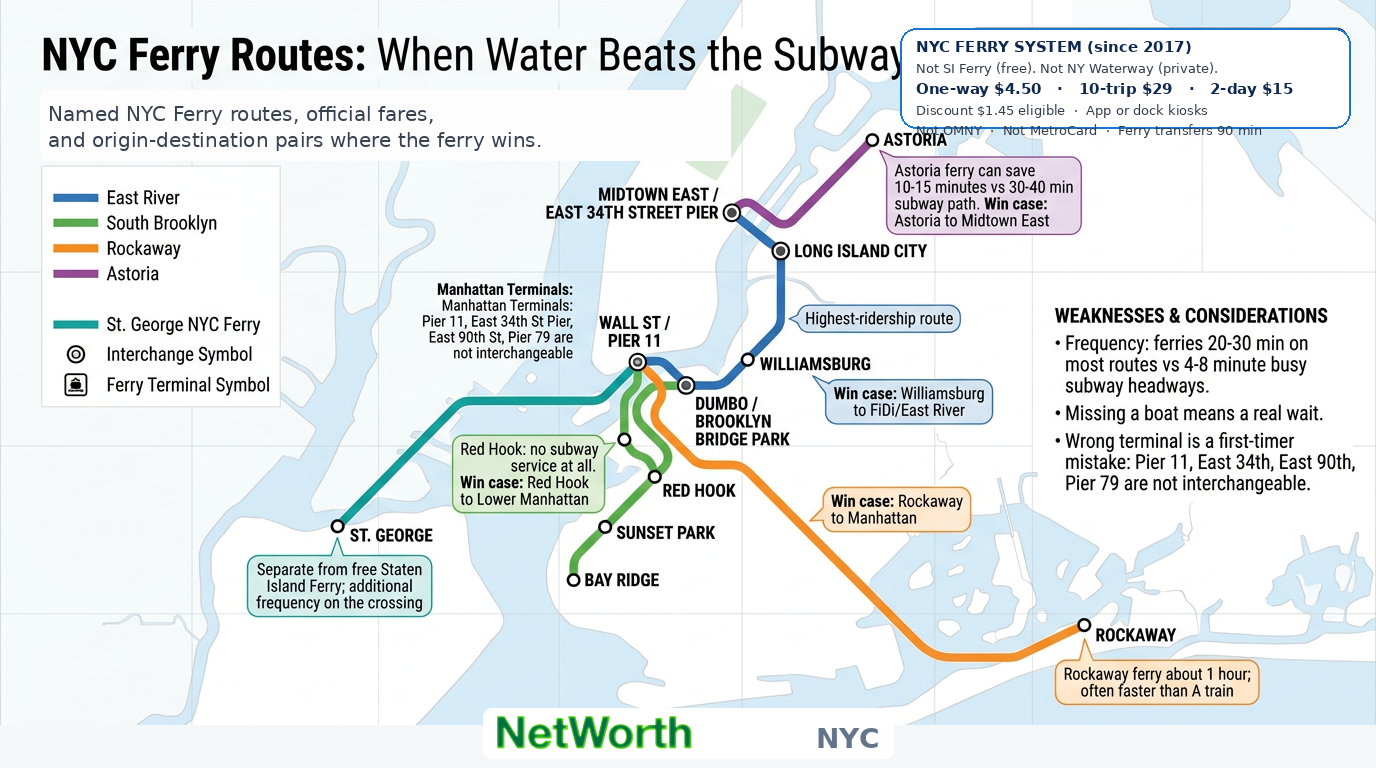
NYC Ferry charges a flat one-way fare of $4.50 on all routes (confirm current pricing on ferry.nyc). A 10-trip pass is $29, and an unlimited 2-day pass is $15 in the app. Eligible riders can use the Ferry Discount Program at $1.45 one-way. Tickets are sold in the NYC Ferry app and at dock kiosks. NYC Ferry does not use OMNY or MetroCard. Free transfers apply between NYC Ferry routes within 90 minutes.
Hệ thống chạy một số tuyến đường được đặt tên và mỗi tuyến phục vụ một phần khác nhau của bờ sông:
Tuyến sông Đông: Chạy giữa Phố Wall/Pier 11 ở Lower Manhattan và Công viên DUMBO/Brooklyn Bridge ở Brooklyn, với các điểm dừng bao gồm Williamsburg và Long Island City ở Queens. Đây là tuyến đường có lượng hành khách cao nhất và là tuyến đường mà hầu hết người dân New York đều biết đến. Nó phục vụ các khu vực lân cận nơi việc tiếp cận Manhattan bằng tàu điện ngầm là gián tiếp hoặc yêu cầu kết nối.
Tuyến Brooklyn phía Nam: Serves the Brooklyn waterfront neighborhoods further from the main subway lines , Bay Ridge, Sunset Park, Red Hook, and others. Red Hook in particular has no subway service at all, making the ferry its primary transit connection to the rest of the city.
Tuyến đường Rockaway: Kết nối Rockaways trong Queens với Manhattan thấp hơn. Chuyến đi mất khoảng một giờ, nghe có vẻ dài cho đến khi bạn so sánh nó với phương án thay thế bằng tàu điện ngầm, vốn yêu cầu tàu A và chạy lâu hơn thế đáng kể. Đối với những người đi du lịch đến hoặc đi từ Far Rockaway, phà thường nhanh hơn và thoải mái hơn.
Tuyến đường Astoria: Kết nối Astoria, Queens với Midtown East Manhattan. Astoria đến Midtown bằng tàu điện ngầm yêu cầu đi tàu N hoặc W và tùy thuộc vào kết nối có thể mất 30-40 phút. Phà đi thẳng đoạn sông Đông.
George, Tuyến Staten Island (Phà NYC): Tách biệt với Phà Staten Island, tuyến này kết nối St. George với Lower Manhattan với lịch trình khác và một số điểm dừng khác. Phà Staten Island vẫn là lựa chọn miễn phí và thường được ưu tiên hơn về mặt chi phí, nhưng Phà NYC cung cấp thêm tần suất trên tuyến đường này.
Khi phà nhanh hơn tàu điện ngầm
Phà thắng đúng giờ đối với các cặp điểm đi-điểm đến cụ thể trong đó lộ trình tàu điện ngầm là gián tiếp:
- Red Hook tới Lower Manhattan: Không có tàu điện ngầm nào phục vụ Red Hook. Các lựa chọn thay thế xe buýt đều chậm. Phà là lựa chọn tốt nhất.
- Williamsburg đến Hạ Manhattan: Tàu L hoạt động nhưng dừng tại Đại lộ số 8 ở Manhattan. Nếu điểm đến của bạn là Khu Tài chính hoặc gần Sông Đông, chuyến phà tới Bến tàu 11 có thể đi thẳng hơn.
- Astoria đến Midtown East: Tùy thuộc vào nơi nào ở Astoria và nơi nào ở Midtown East, chuyến phà có thể tiết kiệm được 10-15 phút.
- Rockaway tới Manhattan: Phà luôn nhanh hơn tàu A trên hành lang này.
The ferry is slower than the subway for most Midtown-to-Midtown or local borough trips. It's a waterfront mode that specifically serves the areas where the subway network hasn't invested.
Trải nghiệm phà so với tàu điện ngầm
The functional difference is significant. A subway car on a crowded weekday morning is a specific kind of experience. The ferry provides an outdoor deck, views of the harbor and skyline, and a slower pace that some commuters value enough to take slightly longer trips.
The ferry is also less crowded than equivalent subway lines at peak hours. Service frequency is lower than the subway (ferries run every 20-30 minutes on most routes, compared to 4-8 minute headways on busy subway lines), so missing a boat means a real wait. This frequency gap is the ferry's main operational weakness.
Lập kế hoạch xung quanh lịch trình phà
Unlike the subway, the ferry runs on a fixed schedule that you need to check before arriving at the terminal. The MTA real-time system tracks subway positions continuously; the ferry departs at specific times and won't wait. Missing a ferry by two minutes means waiting for the next one.
The NYC Ferry app and website publish schedules for each route. The NYC Live Command Center's Transportation panel also shows ferry status and scheduling information alongside MTA subway alerts, making it a convenient single place to check both transit modes before heading out.
Điều mà hầu hết những người lần đầu lái xe đều mắc phải
Hai lỗi thường gặp trong lần đi phà đầu tiên:
Arriving at the wrong terminal. Several Manhattan terminals exist (Pier 11, East 34th Street Pier, East 90th Street, Pier 79 on the West Side). Knowing which terminal your route uses before leaving is essential , these are not interchangeable walk-up stops the way subway stations are.
Không tính đến thời tiết. Boong hở dễ chịu khi thời tiết ôn hòa và khó chịu khi trời mưa hoặc gió lạnh. Tầng dưới kèm theo tồn tại nhưng đã lấp đầy. Những người đi phà mùa đông ở New York là một nhóm tự chọn gồm những người thực sự thích nó.
*The NYC Live Command Center's Transportation panel shows live MTA and NYC Ferry status alongside camera feeds across the five boroughs.*