

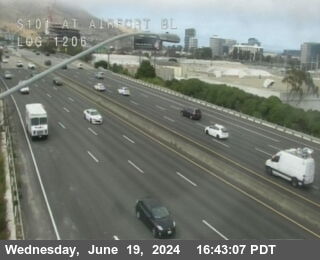
SFO approaches is one of the places people actually search when they want a live look at San Francisco Bay Area. Public Caltrans D4 cameras cover the approaches and junctions around it. You can open them free on our San Francisco Bay Area live grid.
A representative feed is TV406 -- US-101 : AT AIRPORT BL in the South San Francisco area. Related cameras nearby include TV401 -- US-101 : On Airport Flyover Structure, TV398 -- I-380 : West of US-101, TV407 -- US-101 : Just North of I-380. Names come straight from the Caltrans D4 list, so search terms match what you see on the official labels.
Watch SFO approaches live
Open the San Francisco Bay Area camera grid, search for SFO approaches, and watch public Caltrans D4 feeds refresh on their own.
Watch cámaras en vivoQué significa "en vivo" en estos feeds
You get a still image that updates every few seconds (about every 60 seconds on this viewer). That is enough to see queue length, brake lights packing a lane, an empty shoulder, or weather closing visibility. It is not a cinematic angle and it is not interior CCTV.
Night images are darker. Fog and low cloud cut bridge contrast; night frames stay readable on freeways. Even so, flow usually stays readable on freeways and major arterials. You are reading movement and blockage, not shooting a postcard.
What the cameras show near SFO approaches
Feeds around SFO approaches face the roadway. Expect lanes, merge points, signalized junctions, and sometimes a slice of skyline or signage in the background. You will not get storefront interiors, station platforms, or private property cameras from this public set.
Cameras currently matched for this topic:
- TV406 -- US-101 : AT AIRPORT BL (South San Francisco)
- TV401 -- US-101 : On Airport Flyover Structure (South San Francisco)
- TV398 -- I-380 : West of US-101 (San Bruno)
- TV407 -- US-101 : Just North of I-380 (South San Francisco)
- TV397 -- I-380 : JEO EL CAMINO REAL (San Bruno)
- TV395 -- I-380 : at Jct 280 (San Bruno)
Peak pattern: weekday peaks run roughly 6:30-9:30 a.m. and 3:30-7 p.m. Pacific, with bridge backups that linger. If you are deciding whether to leave now or wait twenty minutes, open two or three adjacent cameras rather than one. A single frozen frame can be a truck blocking one lane while the next junction is already clearing.
Incident days look different. A stalled vehicle, lane closure, or weather cell shows up as a sudden stop in the pack, cones, or empty pavement where volume should be. Compare the SFO approaches feed with the next camera upstream before you commit to a detour.
How to open SFO approaches on the live grid
Go to the San Francisco Bay Area cámaras en vivo page. The search box accepts the same strings used in this article. Try "Airport" first. If the label is longer on the agency list, shorten to the road number or junction name.
Click a tile to expand it. Arrow keys move between cameras once a modal is open. Map view plots the same set if you think better in geography than in a grid. No account is required to browse.
Deep links use a query parameter, for example /san-francisco/?q=Airport. Share that URL and the page opens with the filter already applied.
Practical habits that beat a single glance
Open the camera you care about, then one upstream and one downstream. If all three show brake lights, the delay is long. If only one is packed, you may be looking at a local blockage that clears at the next ramp.
Time your check in Pacific time. A quiet frame at 10:40 a.m. says little about 5:10 p.m. For airport runs and event nights, check once the evening before and once before you lock the door.
On mobile, turn the phone sideways for wide freeways. Save the city page to your home screen if you use it daily. Hide cameras that stay dark so the grid stays honest.
Límites que debes esperar
These are traffic management cameras. Coverage favors busy roads, bridges, tunnels, and key junctions. Quiet residential blocks are mostly absent. Labels can be terse. A few tiles will 404 until the agency brings them back.
Image quality varies by age of the dome, sun angle, and compression. Do not treat a blurry night frame as proof a lane is open if you cannot see paint. Switch to a neighboring camera.
Privacy: you are looking at public roadway views operated for traffic operations. Do not try to identify people or plate-hunt. Use the feeds to decide routes and timing.
Reading peak vs off-peak at SFO approaches
Peak frames show dense packs, short gaps, and frequent brake lights. Off-peak frames show longer gaps and higher speeds, which can make the same camera feel "empty" even when volume is moderate. Judge density relative to time of day in Pacific time, not against a mid-day memory.
If you commute the same corridor daily, note where queues usually start. When the queue begins a camera earlier than normal, leave earlier or pick the alternate you already checked upstream.
Related cameras and corridors
Also browse the full San Francisco Bay Area camera grid and the all-cities hub if you are comparing regions. New York City stays on its own Command Center with the larger NYC toolset.
Public Caltrans D4 cameras already exist for operational use. Putting them on one searchable page simply makes the same frames easier to reach when you need SFO approaches in a hurry.